About the challenge
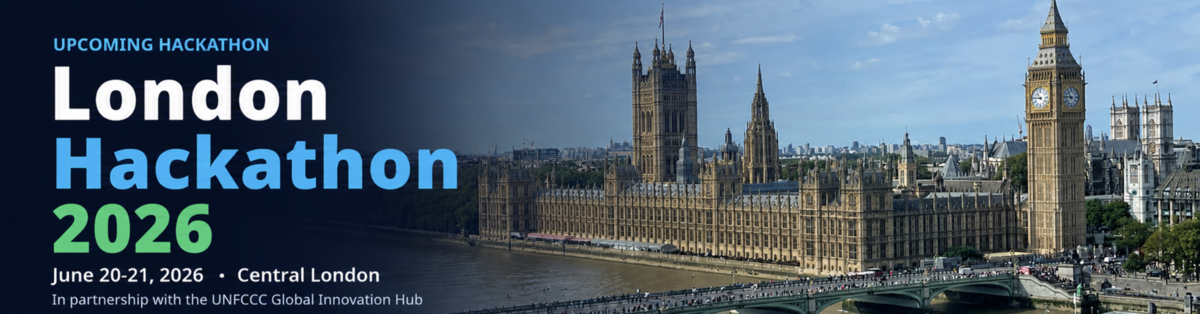
The Health in Climate 2026 London Hackathon is an in-person hackathon during London Climate Action Week hosted in collaboration with the United Nations Climate Change Global Innovation Hub. The weekend will bring clinicians, AI engineers, climate scientists, policymakers, and operators together to ship practical, measurable solutions for acute climate health events. Participants can choose whether they would like to build something to help prepare for, respond to, or recover from climate health events.
➡️ Check out the Challenge Briefs here.
Get started
Are you interested in participating, being a sponsor or speaker, or just want to kept up to date? Fill out this form here.
Requirements
What to Build
Your solution should be concrete and usable, even if it’s early-stage. It can be an app, dashboard, predictive model, decision support tool, policy playbook or anything creative.
The goal is to demonstrate that your idea could work in the hands of clinicians, patients, operators, or policymakers if developed further. At minimum, your build should have two or more of the following:
-
User-facing component — a dashboard, app, or interface that makes insights actionable.
-
Data integration layer — one or more real-world datasets (climate, health, operations, etc.) clearly connected to the problem you’re solving.
-
Analytics or intelligence — rules, models, or algorithms that transform raw data into useful signals.
-
Impact framing — a way to show who benefits (patients, providers, facilities, communities) and how you’ll measure success (fewer ER visits, lower downtime, $/ton CO₂ saved, etc.).
-
Scalability & governance plan — how it could plug into workflows while respecting privacy, compliance, and equity.
For examples of what participants have built at other events, check out our New York Hackathon site here.
What to Submit
One submission per team that includes:
-
Repo link to include install/run steps.
-
Solution demo video (≤3 min) to explain how your solution solves a problem.
-
OPTIONAL - One-pager
-
Problem & users, data sources used, model/approach, and deployment plan.
-
Impact metrics (e.g., predicted ED visits avoided, downtime hours saved, $/ton CO₂e reduced).
-
Data governance (de-identification, PHI handling, licenses/ToS, model card, fairness checks).
-
Prizes
First Place
Second Place
Third Place
Devpost Achievements
Submitting to this hackathon could earn you:
Judges

Nitin Arora
Lead Stakeholder Interaction Unit, UNFCCC

Prof Heiko Baltzer
Director of the Institute for Environmental Futures, University of Leicester

Kitty Parker-Brooks
Expert in Residence on Climate and Health, The Conduit

Catrina Daly
Manager, UCL Centre for Sustainable Business

James Grabert
Director, Mitigation, UNFCCC

Dr. Aditi Joshi
CEO, Ardexia

Tariq Khokar
VP Public Benefit, System

Rich Moyer
Principal and Chief Product Officer, Milliman, Inc

Jasmeet Rai
Founder, Fearless Innovation / Ocean Action
Judging Criteria
-
Impact (5 pts)
Does it have the potential to improve health outcomes or increase resilience to climate risks? -
Team (4 pts)
Is the team interdisciplinary and collaborative in approach? -
AI + Data
Was the solution built using the provided (or relevant) datasets and/or AI tools and frameworks? -
Innovation (3 pts)
Is the idea novel, creative, or unique in approach to solving a climate-health problem? -
Feasibility (3 pts)
Is the solution realistic and actionable, given existing constraints? -
Scalability (3 pts)
Can the idea be expanded beyond the pilot phase? Could it be implemented at scale?
Questions? Email the hackathon manager
Tell your friends
This site is protected by reCAPTCHA and the Google Privacy Policy and Terms of Service apply.